
 By Sara Jasmine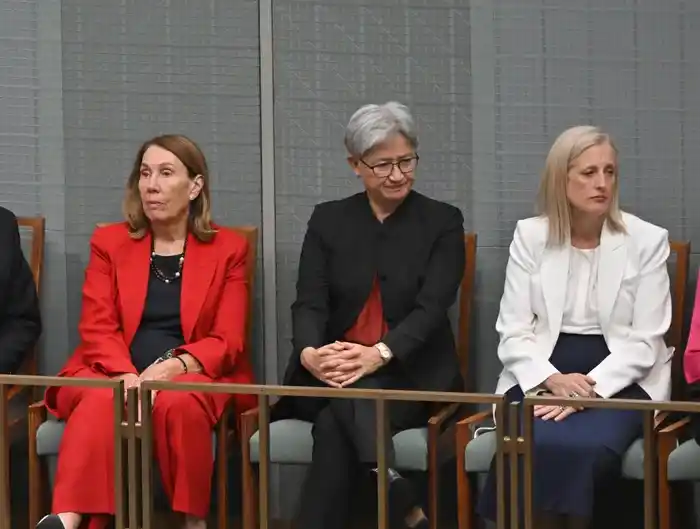
Australia has reached a historic milestone in political representation. For the first time in the nation’s history, women make up the majority of the Australian Labor Party’s federal caucus. The achievement marks decades of advocacy, policy reforms, and cultural shifts designed to increase female participation in politics. Labor has also reached another landmark by appointing an all-female executive, signaling that women now hold unprecedented influence within the party’s organizational structure.
Yet despite these remarkable gains, a striking contradiction has emerged. As conversations begin about who could eventually succeed Prime Minister Anthony Albanese, the names most frequently mentioned remain predominantly male. This disconnect has sparked widespread discussion among political analysts, former lawmakers, and gender equality advocates. If women now outnumber men within Labor’s parliamentary ranks, why are they still largely absent from leadership succession debates?
The issue represents more than a question of political personalities. It highlights a broader leadership paradox seen across governments, corporations, and institutions worldwide: achieving representation does not automatically translate into equal access to the highest positions of power. Australia’s current political landscape offers an important case study of how structural traditions, public perceptions, and media narratives continue to shape leadership opportunities even as gender representation reaches historic highs.
Labor’s female majority is the culmination of decades of intentional reform. Since introducing affirmative action quotas in the 1990s, the party has steadily increased the number of women selected as candidates for federal elections. These policies required local party branches to ensure greater gender balance among nominees, helping address longstanding disparities in political representation.
The results are now evident. Women constitute more than half of Labor’s federal caucus, making Australia one of the few democratic nations where female lawmakers hold a majority within a governing party. Equally significant is Labor’s all-female national executive, demonstrating that women are increasingly influencing both policy development and organizational decision-making.
Former Labor minister Kate Ellis described the achievement as an important milestone rather than the conclusion of the journey toward equality. Greater representation creates opportunities for broader perspectives in policymaking, particularly on issues affecting healthcare, education, childcare, workplace equality, and family policy. However, Ellis and other observers argue that representation alone cannot eliminate deeper barriers that continue to shape political leadership.
Although Labor has successfully increased female participation, leadership succession remains governed by different dynamics than candidate selection. Parliamentary leadership often depends on years of relationship-building, factional influence, cabinet experience, media recognition, and perceptions of electability.
When commentators speculate about Anthony Albanese’s eventual successor, attention frequently turns toward senior male ministers with established leadership profiles. Female ministers who possess comparable experience often receive significantly less media attention despite holding major portfolios.
Political scientists describe this phenomenon as the difference between descriptive representation and substantive leadership. Descriptive representation refers to increasing the number of women in elected office, while substantive leadership involves granting women equal opportunities to attain positions where they influence strategic decisions and national direction.
The gap between these two forms of representation illustrates why numerical equality alone does not eliminate longstanding leadership inequalities.
Australia has made substantial progress toward gender equality, yet political leadership continues to be shaped by cultural expectations developed over many decades.
Leadership has historically been associated with traditionally masculine traits such as decisiveness, toughness, authority, and confrontation. Female politicians often face a more complicated balancing act. They may be criticized if they appear too assertive while simultaneously being perceived as lacking authority if they adopt a more collaborative leadership style.
Research consistently shows that women in politics receive greater scrutiny regarding communication style, appearance, family responsibilities, and personality than their male counterparts. These additional expectations create barriers that extend beyond policy expertise or administrative competence.
Although younger generations increasingly reject traditional gender stereotypes, public perceptions continue to influence political reporting and internal party calculations regarding leadership potential.
Media coverage plays a significant role in determining which politicians are viewed as future national leaders. Leadership speculation often becomes self-reinforcing: the more frequently a politician is mentioned as a potential successor, the more credible that individual appears to both the public and fellow lawmakers.
Studies examining political journalism have found that women frequently receive different types of coverage than men. Articles may emphasize communication style, personality, or work-life balance rather than leadership capability or policy achievements. Even subtle differences in framing can shape public perceptions over time.
When succession discussions consistently highlight male candidates while overlooking equally qualified women, the media inadvertently reinforces traditional assumptions about who appears “prime ministerial.”
This visibility gap can become particularly significant because leadership contests often depend heavily on public recognition before formal campaigns even begin.
Some observers argue that succession conversations simply reflect ministerial seniority or political experience. However, critics note that several female Labor ministers possess extensive cabinet experience, strong electoral records, and significant policy accomplishments.
Women currently oversee major portfolios involving finance, foreign affairs, social services, education, and other areas central to government administration. Many have demonstrated effective leadership during national crises, legislative negotiations, and international diplomacy.
Despite these qualifications, they are often discussed less frequently as potential party leaders than male colleagues with similar or even shorter political careers.
This discrepancy suggests that perceptions surrounding leadership extend beyond objective measures of experience.
Australia’s political history continues to influence contemporary leadership discussions. Julia Gillard became Australia’s first female prime minister in 2010, breaking a significant barrier in national politics. However, her tenure also exposed many challenges facing women in leadership.
Gillard experienced persistent gender-based criticism, public scrutiny, and commentary regarding issues that male leaders rarely encountered. Her famous parliamentary speech condemning misogyny attracted international attention and remains one of Australia’s defining political moments.
Many analysts argue that the treatment of Gillard continues to shape perceptions among current female politicians. Some may hesitate to seek leadership positions because they recognize the heightened level of personal scrutiny involved.
Although Australian political culture has evolved considerably since Gillard’s leadership, her experience illustrates how historical precedents continue influencing contemporary expectations.
Greater gender diversity in political leadership benefits more than symbolic representation. Numerous international studies suggest that diverse leadership teams often improve decision-making by incorporating broader perspectives and experiences.
Women leaders have played central roles in developing policies concerning childcare, parental leave, domestic violence prevention, workplace equity, healthcare accessibility, and education reform. While policy priorities vary among individuals, broader representation helps ensure that governments reflect the experiences of the populations they serve.
Leadership diversity also influences future generations. Visible female leaders encourage younger women to pursue careers in politics, public administration, law, and civic engagement.
Representation at the highest levels creates role models that extend beyond election cycles.
Leadership succession within Australian political parties is shaped by internal relationships as much as public popularity.
Factional alliances, parliamentary support, negotiation skills, electoral strategy, and party unity all influence leadership outcomes. These internal dynamics often remain invisible to the public yet play a decisive role during leadership transitions.
Because many senior party networks developed during periods when men dominated politics, informal relationships may continue favoring established leadership pathways.
As women become increasingly represented across every level of the parliamentary party, these networks are gradually evolving. However, institutional change often progresses more slowly than numerical representation.
Australia is not alone in confronting this leadership paradox.
Across many democratic countries, women have entered legislatures in record numbers while remaining underrepresented among heads of government. Nations including Canada, New Zealand, Finland, Germany, and several Nordic countries have demonstrated that female national leaders can successfully govern complex democracies.
Even so, succession speculation frequently continues to favor male candidates unless women have already established exceptionally high public visibility.
International comparisons suggest that increasing representation is only one stage in achieving leadership equality. Cultural expectations, political institutions, media narratives, and public attitudes must also evolve.
Labor’s female majority represents one of the most significant milestones in Australian political history. It demonstrates that deliberate reforms, sustained advocacy, and changing social attitudes can transform institutions once dominated almost entirely by men.
The next challenge lies not in increasing representation but in ensuring leadership opportunities expand alongside it.
Future leadership contests will reveal whether political discussions evolve to recognize women as equally plausible candidates for the nation’s highest office. As more women accumulate ministerial experience, lead major policy initiatives, and build public recognition, succession conversations may become more reflective of Labor’s changing parliamentary makeup.
Ultimately, true equality is achieved not simply when women occupy seats in parliament but when their leadership potential receives equal consideration without assumptions based on gender.
The Australian Labor Party’s female majority marks an extraordinary achievement in democratic representation. It reflects decades of policy reform and changing public expectations regarding gender equality in politics.
Yet the ongoing absence of women from many leadership succession discussions reveals that representation alone cannot eliminate deeply rooted institutional and cultural barriers. Leadership perceptions are shaped by history, media narratives, political networks, and societal expectations that often evolve more slowly than electoral statistics.
Australia now stands at an important crossroads. If women can become the majority within the governing party, the next logical step is ensuring they receive equal consideration for the nation’s highest leadership roles. Achieving that goal would not only strengthen democratic representation but also signal that political leadership is defined by capability, vision, and experience rather than longstanding assumptions about gender.
As Labor continues to reshape Australia’s political landscape, the true measure of progress will not simply be how many women enter parliament, but how naturally they are viewed as future prime ministers.
- The Guardian. (2026, July 26). Labor women outnumber men in the caucus. Why are they overlooked as Albanese’s potential successor?
- Parliament of Australia. Women in the Australian Parliament: Historical Statistics.
- Australian Labor Party. National Platform and Gender Equality Policies.
- UN Women. Women’s Leadership and Political Participation.
- Inter-Parliamentary Union. Women in National Parliaments.
- Organisation for Economic Co-operation and Development (OECD). Gender Equality in Public Leadership.