
 By Femme Wire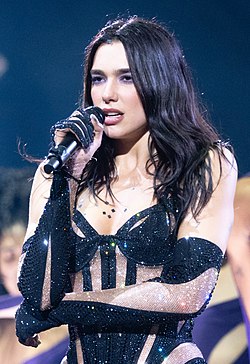
When Dua Lipa released a short teaser clip ahead of her New Year’s Eve performance, it didn’t feel like just another promotional post; it felt like a cultural detonation carefully disguised as a few seconds of motion and light. In the video, she appears encased in liquid-metal couture, a sculptural yet fluid silhouette that seems to melt and reform with every movement, catching light in a way that feels both futuristic and strangely ancient. Within hours, the clip surged to 12 million views, flooding timelines across platforms and triggering the kind of collective fixation that rarely happens organically anymore. This was not simply because Dua Lipa is a global pop star—plenty of celebrities post teasers that fade into the background—but because the look struck a deep aesthetic nerve. The outfit operates at the intersection of performance, fashion, and mythology, evoking molten chrome, cyberpunk armor, and classical statues all at once. It suggests power without rigidity, sensuality without fragility, and spectacle without excess. In a cultural moment increasingly suspicious of obvious extravagance, liquid-metal couture feels like a new visual language: one that communicates dominance and allure through movement rather than volume. The silhouette hugs and releases the body in equal measure, refusing to be categorized as either armor or dress, costume or clothing. This ambiguity is part of its power. Viewers aren’t just watching Dua Lipa tease a performance; they are watching a new aesthetic proposition being introduced in real time. The camera lingers just long enough to let the metal shimmer, to let the fabric—or material, or skin-like surface—suggest motion even when she stands still. It’s hypnotic, and crucially, it’s designed for the digital age, where fashion must perform not only on bodies but on screens, loops, and algorithms. The 12 million views are not just a measure of popularity; they are proof that this image works as content, as iconography, and as a template waiting to be replicated.
What makes the response even more significant is how quickly designers, stylists, and brands began scrambling to decode and reproduce the silhouette. Within days, mood boards surfaced across Instagram and TikTok, sketching out liquid-metal gowns, reflective bodysuits, and molten textures clearly inspired by Dua Lipa’s look. This kind of rapid aesthetic uptake speaks to a fashion industry operating under intense pressure to remain relevant in a hyper-accelerated trend cycle. Traditionally, a red-carpet moment might influence collections months or even years later, filtered through runway seasons and editorial interpretation. But the liquid-metal moment bypassed those structures entirely. It moved at internet speed, demanding immediate response. Designers are not just copying the material; they are chasing the silhouette itself—the way it appears poured rather than sewn, grown rather than constructed. This reflects a broader shift in how fashion innovation is perceived. The most valuable ideas today are not necessarily new fabrics or techniques, but new shapes that photograph and animate well, shapes that feel inevitable once seen. The liquid-metal silhouette offers that sense of inevitability. It feels like something that has always existed in the future we imagined but had never quite materialized until now. At the same time, it taps into a long lineage of fashion experimentation with metallics and body-conscious design, from Paco Rabanne’s chainmail dresses to Thierry Mugler’s biomechanical fantasies. What differentiates Dua Lipa’s moment is restraint. The look is not overloaded with references; it distills decades of futuristic fashion into a single, coherent statement. Designers scrambling to replicate it face a difficult challenge: without the precise balance of fluidity and structure, the look can easily tip into gimmick or costume. Yet the demand is undeniable. Consumers, stylists, and even fast-fashion brands are hungry for versions of this silhouette that feel wearable, adaptable, and accessible. This creates a familiar tension between artistry and commodification. As copies proliferate, the original risks dilution, but it also cements its status as a defining aesthetic of the moment. The scramble itself becomes part of the story, reinforcing the idea that Dua Lipa didn’t just wear a striking outfit—she introduced a form that the industry now has to contend with.
Beyond the immediate fashion fallout, the liquid-metal teaser reveals something deeper about how pop stardom, visual culture, and desire operate today. Dua Lipa has consistently positioned herself not just as a musician, but as a curator of aesthetic worlds, using fashion as a narrative tool rather than mere decoration. This teaser continues that strategy with remarkable precision. The liquid-metal look aligns perfectly with New Year’s Eve as a symbolic moment: a threshold between past and future, solidity and transformation. The material appears in flux, neither fully solid nor fully liquid, mirroring the cultural mood of uncertainty and reinvention. Audiences aren’t just excited about what she will perform; they are excited about what this image promises emotionally. It suggests reinvention without erasure, strength without aggression, and glamour without nostalgia. That is a powerful combination in a time when pop culture often oscillates between recycling the past and chasing novelty for its own sake. The virality of the clip also underscores how performance has expanded beyond the stage. The teaser itself is a performance, engineered to circulate, to be paused and replayed, to invite analysis frame by frame. Fashion becomes choreography, and choreography becomes branding. In this ecosystem, a silhouette can be as influential as a song hook. The fact that designers are scrambling to copy it is not just a testament to its beauty, but to its narrative clarity. It tells a story instantly, without explanation. As the copies roll out and the trend inevitably evolves, the original moment will remain fixed as a reference point—a reminder of how a few seconds of liquid-metal motion reoriented the fashion conversation. Dua Lipa’s teaser didn’t just preview a New Year’s Eve performance; it set the tone for what glamour, power, and futurism might look like in the year ahead. In doing so, it reaffirmed that in contemporary culture, the most influential fashion moments are no longer confined to runways or red carpets, but emerge where music, image, and technology collide, molten and luminous, ready to be reshaped by whoever dares to follow.
 Sara Jasmine